
OnlyFans subscribers rarely think of themselves as belonging to a spending category, yet most settle into one within a few months. If you have ever wondered why your monthly outlay looks nothing like a friend’s despite similar interests, the answer usually sits in a self-imposed ceiling rather than in the pages themselves. BestOnlyFans reader surveys point to three broad budget tiers that shape nearly every decision a subscriber makes: micro (up to $10 monthly), moderate ($10-$30), and expansive (above $30). This guide maps the habits inside each cluster, explains how people drift between them, and shows how to borrow habits from a neighbouring tier when your current pattern stops working.
It is a set of routines built around a number you decided, often without writing it down, and those routines become visible in how you discover pages, how long you stay subscribed, and how you respond to pay-per-view messages. BestOnlyFans refreshes its rankings every month.

The Micro-Tier Explorer Profile
The paid subscription floor on the platform is $4.99, so a micro-tier budget usually means one paid page at the minimum, several free pages set to $0, and a strict attitude toward anything extra. Free pages monetize through pay-per-view messages and tips rather than a base price, which makes them the natural home for this cluster.
Discovery is the hardest part of micro-tier life because the platform has no built-in discovery feed or directory. Subscribers in this bracket depend heavily on external social channels and on ranking sites to find pages that match a niche before committing even $4.99. Promotional first months, which can legally sit below the $4.99 base minimum, matter enormously here.

Five behaviours show up again and again in this cluster:
- Following the maximum number of free pages while enforcing a strict per-message PPV ceiling, often $3-$5.
- Subscription duration averaging under 30 days, with frequent cancellation once initial novelty fades.
- Discovery through external social channels rather than any platform tool, since none exists.
- High sensitivity to promotional first-month pricing, with renewals timed around discounts.
- Manual budget tracking across many small transactions that individually feel insignificant.
Notice that the $0.10 card verification hold, refunded within days, is not a real cost but does appear on statements and can confuse manual tracking.
Moderate-Tier Subscriber Rhythms
A typical member holds one primary paid subscription in the $4.99-$15 band, where most pages cluster, plus one rotating slot for exploration. What separates moderate from micro is structure: renewal dates get reviewed before auto-renewal processes, and ranking sites become a genuine research tool rather than a curiosity.
Price history matters here because it reveals the true long-term cost of a page once a promotional month ends and the base price resumes. A $3 first month tells you nothing about month four, and moderate-tier subscribers learn that distinction faster than any other cluster.

Four structural habits define this cluster:
- Maintaining one primary paid subscription alongside a single rotating exploratory slot.
- Reviewing renewal terms on a calendar before auto-renewal charges the card.
- Using ranking site price history to separate promotional pricing from steady-state cost.
- Reconciling actual quarterly spending against the intended budget at least once per season.
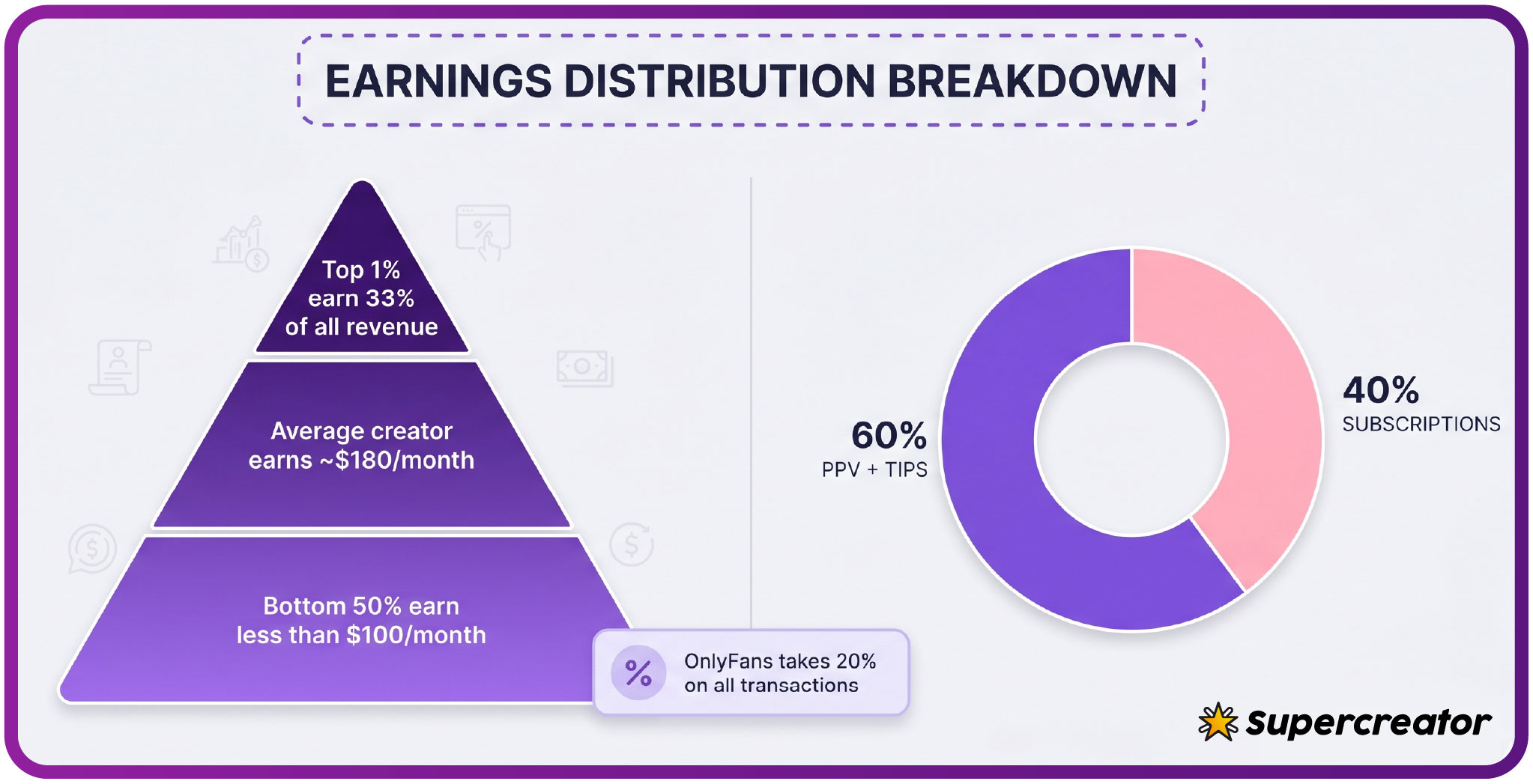
With a 20% platform fee on everything, the creator keeps 80%, and understanding that split changes how people evaluate tips, PPV unlocks, and paid chat. A $4 message in chat is not the same commitment as a $50 PPV unlock, and moderate-tier members start distinguishing between the two deliberately.
Expansive-Tier Engagement Patterns
Subscribers here often hold four or more concurrent subscriptions, treating each page as one position in a broader mix. The averaging effect matters: a disappointing page matters less when spread across a wider set, which reduces individual price sensitivity.
Custom requests become normal rather than exceptional, integrated into monthly planning the way any discretionary purchase would be.
Five markers distinguish expansive-tier subscribers:
- A subscription portfolio of four or more creators running at the same time.
- Regular custom content requests built into the monthly plan rather than treated as surprises.
- Tipping as deliberate relationship investment instead of impulse reaction.
- Lower sensitivity to any single page’s price because the portfolio averages the cost.
- Higher use of multi-month and annual bundle commitments where creators offer them.
Warning: promotional lock-in is the most common expansive-tier trap. When several creators run discounted first months simultaneously, the renewed base rates can arrive in the same billing cycle, producing a spike that portfolio averaging hides until the statement lands.
When a creator raises the base price, auto-renew stops and existing access continues until the paid period ends. Expansive-tier subscribers encounter this more often simply because they hold more subscriptions, so renewal monitoring becomes a genuine administrative task rather than an afterthought.
Cross-Tier Drift and Budget Creep Mechanisms
Movement between tiers is rarely a decision. It is an accumulation. Micro-tier explorers drift upward when PPV unlocks across several free pages sum past $10 without a single memorable purchase.
Moderate-to-expansive drift usually follows relationship development. Once custom requests normalise, the marginal cost of one more subscription feels small relative to a portfolio that is already established. Downward drift happens too, most often after an annual renewal audit produces a number the subscriber did not expect.
| Drift Direction | Primary Trigger | Typical Monthly Impact |
|---|---|---|
| Micro to moderate | Undetected PPV accumulation across multiple free pages | +$5 to +$15 over two to three months |
| Moderate to expansive | Custom request normalisation and creator relationship depth | +$15 to +$30 over one to two quarters |
| Expansive to moderate | Annual renewal audit revealing total outlay | -$15 to -$40 within one billing cycle |
| Moderate to micro | Income instability or deliberate interest consolidation | -$10 to -$25 within one to two months |
Four pathways account for nearly all observed drift:
- Micro to moderate through undetected PPV accumulation on several free pages at once.
- Moderate to expansive through creator relationship development and custom request normalisation.
- Expansive to moderate after an annual renewal audit exposes the full annual figure.
- Moderate to micro during income instability or a deliberate consolidation phase.

The timeline above shows how quickly the subscriber base expanded across tiers, which matters because drift mechanisms scale with the number of available pages. More choice means more small decisions, and more small decisions means more chances to move tiers without noticing.
Ranking Site Usage Patterns by Cluster
Micro-tier subscribers filter aggressively on price, moderate-tier subscribers balance price against activity signals, and expansive-tier subscribers often ignore ranking indicators in favour of direct creator relationships they already trust.
For anyone hunting value inside tight constraints, the pages collected under best only fans no ppv illustrate why filtering discipline matters more than browsing volume. Comparing at least two ranked options before any renewal decision is a habit that pays for itself, and it takes less time than scrolling through a dozen unranked pages.
| Budget Tier | Primary Ranking Feature Used | Typical Search Behaviour |
|---|---|---|
| Micro (up to $10) | Price filters and category sorting | Narrow niche search with hard price ceiling applied first |
| Moderate ($10-$30) | Price history depth and activity metrics | Compares two or three candidates before renewal dates |
| Expansive (above $30) | Creator stability scores | Minimal searching, mostly direct return visits |
Category filters see disproportionate micro-tier use, since niche alignment inside a tight budget requires precision rather than breadth, and the BestOnlyFans price history depth matters most to moderate-tier subscribers timing renewals around promotional cycles.

Support and billing questions cluster differently too. Micro-tier subscribers contact the help centre most often about the $0.10 verification hold and unexpected renewals, while expansive-tier subscribers ask about multi-subscription billing cycles.
Intervention Points for Sustainable Habits
The goal is not to spend less for its own sake but to make each charge a decision rather than a default.
- Micro-tier subscribers should implement a weekly transaction review and a hard PPV cap per page, so accumulation becomes visible before it crosses the $10 line.
- Moderate-tier subscribers should assign quarterly creator value scores that trigger either continuation or cancellation, replacing passive renewal.
- Expansive-tier subscribers should enforce a maximum concurrent subscription count with mandatory culling before any new addition.
Enabling two-step authentication protects the payment method attached to every subscription, and a compromised card can generate charges that look like ordinary tier drift until you audit the statement line by line.

Phishing attempts that imitate billing notices are a recurring problem for subscribers at every tier, and they are covered thoroughly by phishing scams guidance that applies directly to subscription platforms. The practical rule is simple: never enter payment details through a link in a message, and always navigate to the account settings page yourself.
Self-Assessment and Tier Migration Planning
Subscribers routinely underestimate their true monthly total by 30% or more because charges arrive separately and each one feels small in isolation.
Moving from micro to moderate deliberately means choosing one additional paid page at a known base price and removing a free page to offset it. Moving downward means cancelling the lowest-value subscription first and letting the remaining portfolio prove itself for a full cycle before any further change.
Two things make migration stick. Tracking every charge for a full month comes first, followed by a repeat review after 30 days using the same honesty as the initial count.

The 2020 surge in the chart above reshaped what a normal subscriber portfolio looks like, because page supply grew faster than most people’s budgeting habits adapted.
FAQ
How do I know which budget tier I actually belong in versus where I started?
Add up every charge across all pages for the last complete month, including tips, PPV unlocks, and paid chat. Compare the total to the boundaries: up to $10 is micro, $10-$30 is moderate, above $30 is expansive.
Can I maintain micro-tier habits while occasionally using moderate-tier features?
You can unlock a $50 PPV message or send a tip in a given month and still stay under $10 overall only if you cancel something else to compensate.
Why do expansive-tier subscribers sometimes resist ranking site recommendations?
Portfolio averaging reduces the perceived cost of any single page, so ranking signals feel less relevant than the direct relationship already established. That is rational up to a point, but it also delays recognition when a page’s value drops, because no external comparison is being made.
What is the most common sign that I’m drifting into a higher spending tier unintentionally?
Renewal notices stop being predictable. When charges arrive on dates you did not expect, from pages you forgot you kept, accumulation has already started.